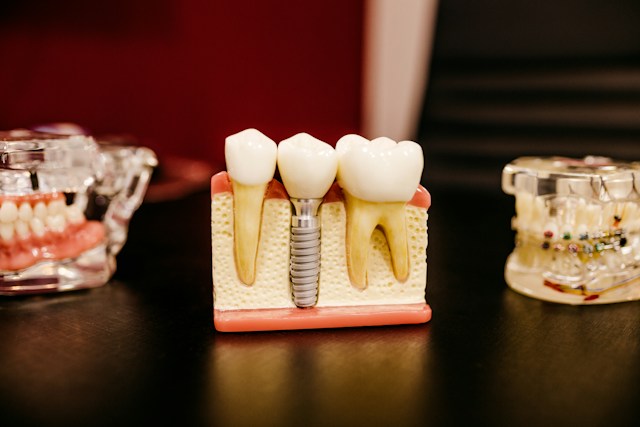
If you have lost a tooth, the two most common fixed replacements are a dental implant and a dental bridge. Both give you a fixed tooth that you don't take out at night. But they work very differently, and the right choice depends on your bone, your neighbouring teeth, your timeline and your budget.
The short answer
For most adults with healthy gums and enough jawbone, an implant is the better long-term choice because it replaces the tooth root, does not touch the teeth on either side, and helps preserve the jawbone. A bridge can be the better choice when the neighbouring teeth already need crowns, when there isn't enough bone for an implant, or when you need a fixed tooth quickly.
How each option works
Dental implant
A small titanium post is placed in the jawbone where the root used to be. Over roughly 3 to 6 months the bone bonds to it. A custom crown is then fixed on top. The implant stands on its own, like a natural tooth.
Dental bridge
The teeth on either side of the gap are shaped and covered with crowns. A false tooth is joined between them, so the bridge is held up by your own teeth. Treatment usually takes two or three visits over one to two weeks.
Implant vs bridge: side by side
- Effect on other teeth: An implant leaves neighbouring teeth untouched. A bridge needs the teeth on both sides to be trimmed for crowns.
- Jawbone: An implant stimulates the bone and helps prevent it shrinking. Under a bridge, the bone where the tooth was lost slowly shrinks.
- Lifespan: With good care, implants commonly last decades. Bridges typically last 10 to 15 years before they need replacing.
- Cleaning: You brush and floss an implant like a normal tooth. Under a bridge you need floss threaders or interdental brushes.
- Time: An implant takes a few months from start to final tooth. A bridge can be finished in about two weeks.
- Upfront cost: An implant usually costs more upfront. Over 15 to 20 years it often works out similar or cheaper, because a bridge may need replacing.
When an implant is the better choice
- The teeth next to the gap are healthy and you don't want them cut down.
- You want the longest-lasting option and are happy to wait a few months.
- You are missing several teeth; implants can also support bridges and full arches, such as All-on-4.
When a bridge may make more sense
- The neighbouring teeth already have large fillings or crowns, so covering them adds protection.
- There isn't enough bone and you prefer not to have a bone graft.
- You have a medical condition that makes minor surgery unsuitable.
- You need a fixed tooth quickly, for example before an event or travel.
Making the choice with a 3D scan
Every implant case at our GK-1 clinic is planned on a 3D CBCT scan, which shows exactly how much bone is available and where the nerves and sinuses are. Dr. Ameet S. Dixit, BDS Gold Medalist and Ex-Resident of AIIMS New Delhi, has placed over 17,000 implants since 2007 using Straumann and Nobel Biocare systems. If a bridge would serve you better, we will tell you so. You can read more on our dental implants page.
Frequently asked questions
Will a bridge damage my other teeth?
The supporting teeth are permanently reshaped for crowns, and they carry extra load. Kept clean, they can stay healthy for many years, but if one develops decay the whole bridge may need replacing.
Can I get an implant years after losing a tooth?
Often, yes. If the bone has shrunk, a bone graft can rebuild it first. A CBCT scan shows whether you need one.
Can a bridge be replaced with an implant later?
Yes. When an old bridge fails, many patients switch to implants, although the trimmed neighbouring teeth will still need crowns.
Am I too old for an implant?
There is no upper age limit. Overall health and bone quality matter more than age.
Book a consultation in GK-1
Not sure which option suits you? A consultation with a CBCT scan gives a clear answer. Ark Dental Global is at R-27, 1st Floor, Greater Kailash-1, New Delhi 110048, open Monday to Saturday, 10 AM to 8 PM. Call or WhatsApp +91 99905 09300, or book online.