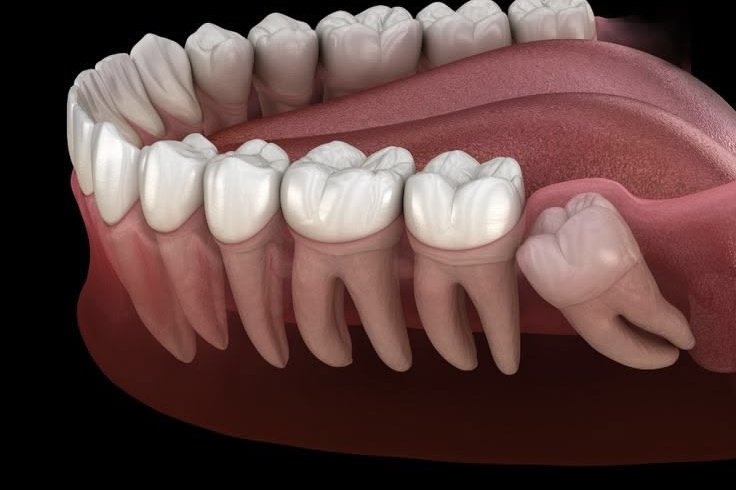
Wisdom teeth usually arrive between the ages of 17 and 25, and for many people they arrive with pain. The good news: a painful wisdom tooth does not always need to be removed. What matters is why it hurts and how it is positioned.
The short answer
If the tooth is coming through straight and you can keep it clean, short-lived soreness often settles in a few days. If it is stuck under the gum or bone (impacted), keeps getting infected, or is damaging the tooth in front, removal is usually the better long-term choice. An X-ray decides it.
Why wisdom teeth hurt
- Erupting through the gum: the gum over the tooth stretches and becomes tender.
- Pericoronitis: food and bacteria get trapped under a flap of gum over a half-erupted tooth, causing swelling, a bad taste and pain on swallowing.
- Impaction: the tooth grows at an angle and pushes against the tooth in front or stays trapped in the bone.
- Decay: wisdom teeth are hard to reach with a brush, so they decay more easily.
Safe relief while you wait for an appointment
- Rinse with warm salt water several times a day, especially after eating.
- Brush the area gently with a soft brush to clear trapped food.
- Take an over-the-counter painkiller as directed on the pack.
- Use a cold pack on the outside of the cheek for swelling.
- Don't place tablets or clove oil directly on the gum; they can burn it.
Signs the tooth probably needs to come out
- Repeated episodes of swelling or infection around the same tooth.
- Decay in the wisdom tooth, or in the back of the tooth in front of it.
- Pain that keeps returning every few weeks or months.
- A cyst or bone loss around the tooth on the X-ray.
- Difficulty opening your mouth fully, along with swelling.
Go to a hospital emergency department straight away if swelling spreads towards your eye or neck, or makes breathing or swallowing difficult.
What removal involves
A fully erupted wisdom tooth can usually be removed like any other tooth, under local anaesthesia, in a short appointment. An impacted tooth needs a small surgical procedure: the gum is opened, the tooth is sometimes divided into pieces to remove it gently, and the area is stitched. For lower wisdom teeth close to the jaw nerve, a 3D CBCT scan helps plan the safest approach.
Recovery: what to expect
- Swelling usually peaks on day 2 or 3 and settles within a week.
- Eat soft, cool foods for the first few days and chew on the other side.
- Avoid smoking, spitting forcefully and using a straw for 48 hours, so the healing clot stays in place.
- From the next day, rinse gently with warm salt water after meals.
- Call us if pain gets worse after day 3; this can be a "dry socket", which is easily treated.
Frequently asked questions
Should healthy wisdom teeth be removed just in case?
Not always. If they are fully through, cleanable and not causing problems, many can stay. We check them at regular visits.
At what age is removal easiest?
Removal is generally easier in the late teens and twenties, when the roots are not fully formed and the bone is softer.
Can all four be taken out at once?
Sometimes, depending on their position and your comfort. Many patients prefer to do one side at a time so they can still chew on the other.
Will my face swell a lot?
Some swelling is normal after surgical removal. Cold packs in the first 24 hours and the medicines we prescribe keep it manageable.
Wisdom teeth are part of our general dentistry care at GK-1.
Book a consultation in GK-1
A quick examination and X-ray tells you whether your wisdom tooth needs to come out. Ark Dental Global is at R-27, 1st Floor, Greater Kailash-1, New Delhi 110048, open Monday to Saturday, 10 AM to 8 PM. Call or WhatsApp +91 99905 09300, or book online.